
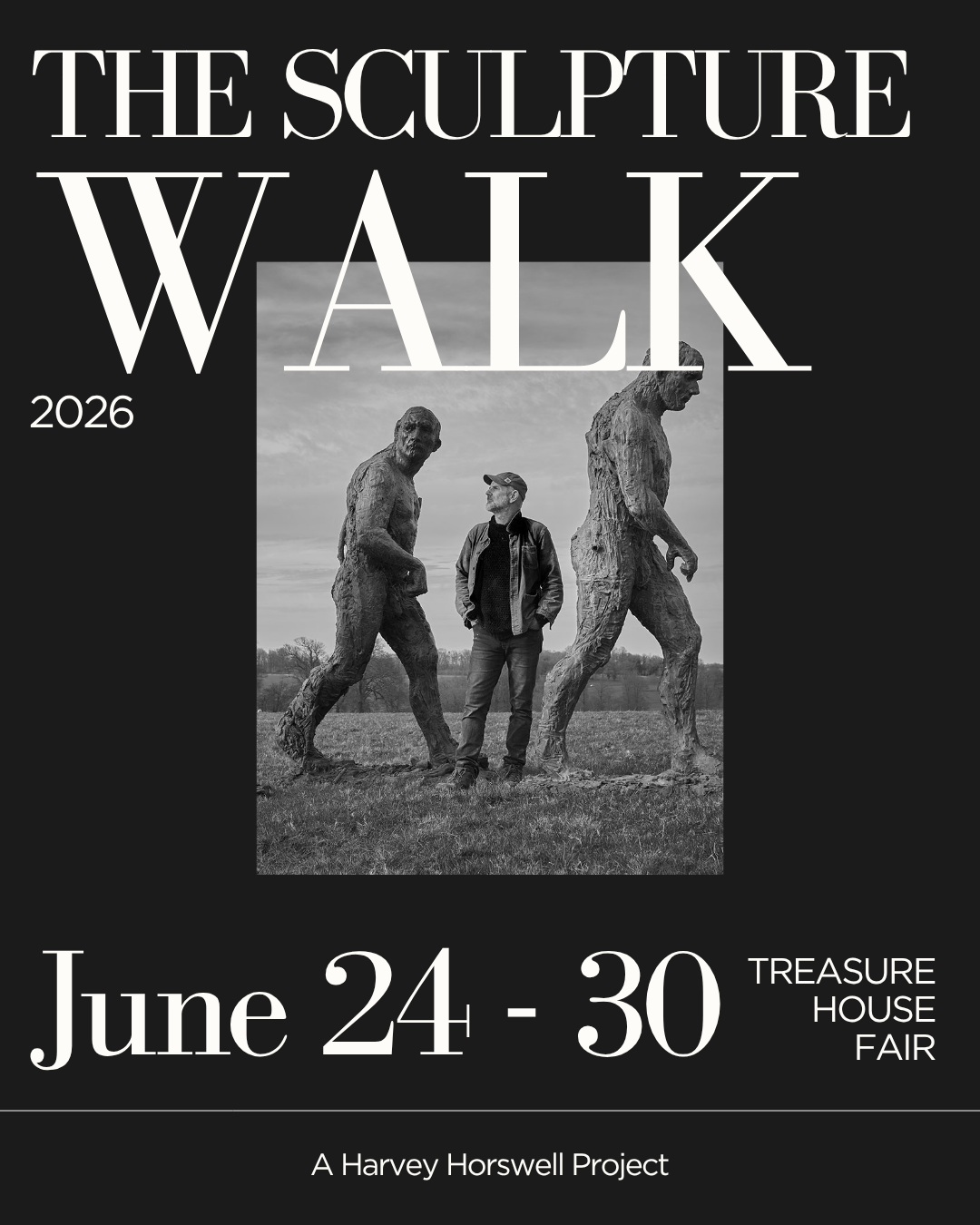
Sculpture Walk Director
The Walk is a project I feel deeply passionate about. After forty-seven art fairs on the gallery side as a sculpture dealer, I had always wanted to do more with the sculpture that decorated the aisles, to bring it forward, to give it a context and a conversation. In 2025 I was expecting perhaps ten works. We had twenty-seven. I wondered, quietly, whether I had over-talked it. But the Treasure House audience responded, and responded generously. Not only in physical visitors to the Walk itself, but in listening to the podcast that accompanied it, which has recorded nearly four thousand listens since the Walk closed last year. This year we are approaching forty works. Sculpture, it seems, is back.
What makes the Sculpture Walk singular is that it winds through an art fair, a temporary structure, and that it brings together works from some of the world's leading gallerists alongside independent artists and estates. There is no equivalent. It is this confluence, I believe, that gives the Walk its life and that will keep it fresh year upon year. For the collector, whether newly arrived or long established, this breadth of work and material offers something rare: the opportunity to develop your eye, not only to what has become a traditional icon of sculpture, but to what is happening now in contemporary studios across the world.
Sculpture is one of the most complex mediums to collect. I say this braced for the uproar from every other discipline on reading it. But the complexity is real, and it stems largely from the life a sculpture has beyond its creator, in multiples, in posthumous casts, and increasingly in the choices available to a collector at studio level about the medium in which they wish to acquire a work. This is also, however, the joy of collecting sculpture. That complexity, born of the many hands involved in the creation of each individual cast, is precisely what makes it so endlessly interesting. The question I am asked more than any other is this: how can you tell what is a good cast? How do you learn to judge? The honest answer is years of looking and handling, of seeing different casts and mediums placed beside one another, of talking with experts, artists and makers. The Walk can begin that journey, and I hope for many visitors it will begin a lifelong passion, simply because there is nowhere else where such a breadth of sculpture and material can be viewed, with either a leading expert or the creating artist present beside each work.
Those same experts can tell you where another example of a work can be found, and we have included that information at the back of this catalogue. There is something genuinely special about sitting in your home with a work, knowing that another cast stands in the Louvre, or about lending your example to a museum and seeing your name on the opening night listing. That is sculpture's gift to the collector: in having to navigate the complexities of editioning and origin, the reward on the other side is that you may stand in the Met and recognise something you have in your garden.
There is a further way to develop your eye within the fair itself. You can trace a work back to the exhibitor who brought it across the fair map and discover other works from the same period, assembled by the same dealer, and in doing so begin to understand the context in which a sculpture was made. Context is vital when selecting sculpture. We cannot pretend otherwise. The practical realities alone, complex shipping, the sheer physical weight of works that once placed are not easily moved, mean that the decision to acquire is a considered one. Having the breadth of the fair, and the range of expertise within it, is a genuine advantage to any collector at that moment of decision.
Sculpture has always carried weight in the human story, in both senses of the word. The very first built homes discovered by archaeologists, those earliest structures after we left the caves, contained small sculptures. Today, you cannot walk a city without encountering a monument or a new installation. The medium has never truly been absent. It has simply, at certain moments, waited to be rediscovered.
It is my deepest hope that the Walk begins that rediscovery in this beloved medium for those who are new to it. Welcome to the Sculpture Walk 2026.
Flo Horswell
The Sculpture Walk
Harvey Horswell Ltd.
Flo Horswell - Interview
How has the walk got so large? I was expecting around 10 works from exhibitors and a few independent artists and estates as this was the most amount of works a fair in this location fair had ever had – or perhaps any fair within its own footprint. Instead we had 27 sculptures and I am very lucky that so many exhibitors, and independents trusted that I could make it work – not to mention poor Stabilo the builders who suddenly had to adapt walls and spaces to fit these works in. This year in 2026 we are currently at 36 works.
I can’t think of anywhere else where you can come and see such a range from the 17th century to works being made for the fair by innovative contemporary artists, all from some of the top experts in the world, all collaborating together.
Founders talk about imposter syndrome, I don’t think I had it the first year or I would have been more daunted, but now I have awe syndrome watching dealers coming back with what is in effect a HUGE investment – the shipping of works such as these often start at around £3,500 – plus of course the returning independents some of whom are bringing two pieces.
Where did the idea come form? The idea stemmed from my own frustration as a sculpture dealer for many decades at sculpture having previously felt like a space filler, with little being returned to the exhibitors after outlaying another huge expense on top of their stands. However, it was the vision of the directors of The Treasure House Fair who developed that frustration by asking me to put my energy where my complaining mouth was. I wanted to see if we could turn it into an additional draw to the fair, if we could give back in return a digital programme beyond the fair and direct interaction with the works to the dealers who were investing so much in bringing sculpture to the fair. I am proud to say we did that in the first year and that this year the walk is developing into a place for clients to come to be exposed to a breadth of sculpture, alongside the Treasure House Fair itself.
Where do I see The Walk in the years to come? I am passionate about making the walk so financially independent we can open the door to more independent artists by grants who cannot afford to take part or more importantly even ship to the fair and beyond that into perhaps a bursary to allow the works to be cast. For that we need sponsorship and to prove The Walk has longevity, which in these times is going to be tricky. As part of that extending the time frame of course would be the dream – to take the walk from a week at the fair onto a space where it could rest for three months. Within that context imagine how many people we could expose to sculpture – from corporate events to children’s programmes to working in conjunction with landscape gardeners to reconnect sculpture with the great garden designs as it was in the time of Christopher Wren, in front of whose building The Sculpture Walk began. Perhaps a Winter Walk through the galleries and studios where this work comes from would be a the next more accessible stage.
However, we go forward I think we cannot deny when you look at the blockbusting exhibitions that Sculpture is having its moment – from Pangolin’s Chadwick exhibition at Houghton Hall to Christie’s Brancusi being sold at $107.6 million dollars. Long may it continue and I hope The Walk can be the starting point for new passionate enthusiasts of sculpture.